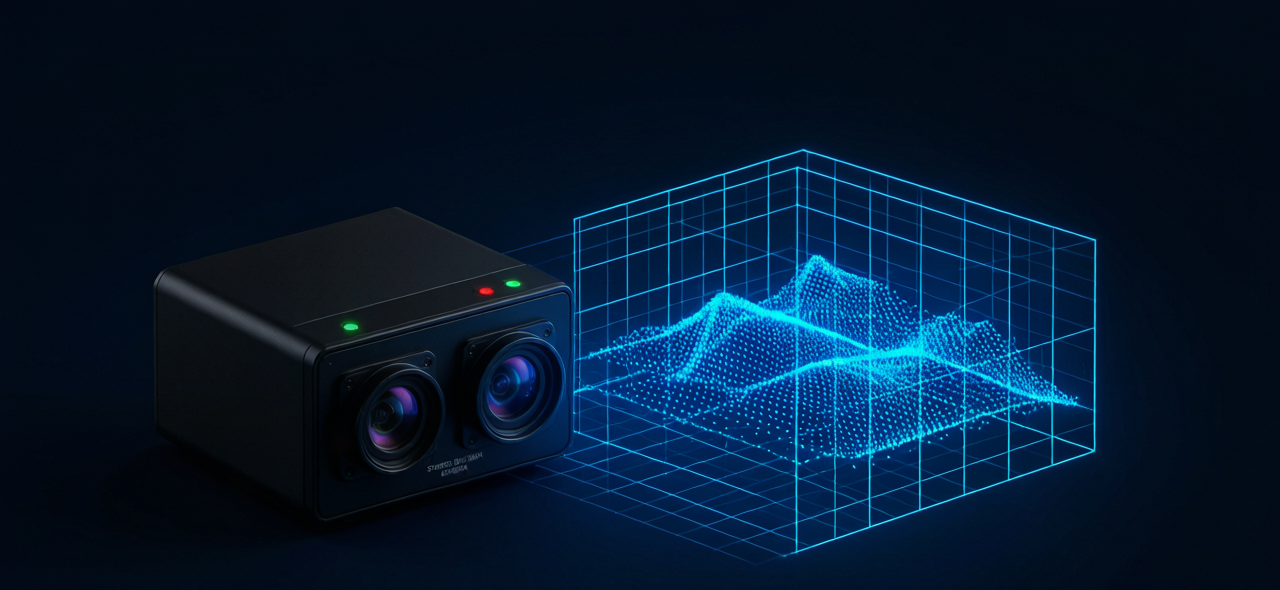
Orbbec and Ant Group’s embodied intelligence subsidiary LingBot Technology have announced a deepened partnership, unveiling both a new data collection hardware platform and the next-generation LingBot-Depth 2.0 spatial perception model. The collaboration aims to accelerate the deployment of embodied intelligence in real-world robotics scenarios.
LingBot-Depth 2.0: A New Standard in Spatial Perception
Trained on a dataset of 150 million samples, LingBot-Depth 2.0 represents a significant leap forward in depth completion and spatial understanding. The model has been certified by Orbbec’s Deep Vision Laboratory and delivers impressive performance improvements:
- 12 out of 16 first-place results in depth completion benchmarks
- RMSE reduced from 0.132 to 0.062 in the most challenging indoor large-area depth missing scenarios — a 53% improvement
- Exceptional performance on glass, mirrors, transparent objects, and other traditionally difficult materials
- Significant upgrades in edge clarity, small object recognition, long-range depth estimation, and complex scene robustness
Compared to industry-leading solutions like Stereolabs’ ZED Stereo Depth camera, the combination of Orbbec’s Gemini 330 series with LingBot-Depth produces smoother, more complete depth maps with sharper object edges — even in the most optically challenging environments including transparent glass, highly reflective mirrors, and strong backlighting.
Orbbec’s Data Collection Hardware Platform
Alongside the model release, Orbbec launched its bodyless data collection hardware platform, comprising multiple product form factors:
- EGO RGB-D: First-person perspective interaction data collection
- UMI: Environmental observation data capture
- WristCam: Near-field wrist-mounted observation for hand-object interaction detail capture
The platform provides standardized products, contract manufacturing (CM), and joint design manufacturing (JDM) services for embodied intelligence model companies, robot body manufacturers, data collection service providers, and algorithm-driven enterprises.
EGO RGB-D: Chip-Level Depth + Model Enhancement
The flagship EGO RGB-D system represents a unique “chip-level depth output + model-level depth enhancement” approach developed jointly by Orbbec and LingBot:
Hardware side: The EGO RGB-D integrates Orbbec’s Gemini 330 series stereo 3D camera, powered by the proprietary MX6800 depth engine chip designed specifically for robotics applications. The system can synchronously capture RGB images and high-precision depth data with low latency and stable output.
Model side: The raw depth output from the hardware is enhanced by LingBot-Depth 2.0, which fills in missing depth data, optimizes object edges, and improves spatial structure details. This is particularly effective for reflective, transparent, and occluded edge scenarios where traditional depth cameras typically fail.
Roadmap: Toward Integrated 3D Camera + AI Products
Looking ahead, Orbbec plans to release an SDK product integrating LingBot-Depth capabilities, enabling robots using Gemini 330 series cameras to benefit from enhanced depth performance at the edge. The company also plans to launch an integrated camera product with LingBot-Depth commercial edition as early as end of 2026, delivering “3D camera + spatial perception capability” as a unified solution.
Strategic Context
This partnership builds on the January 2026 release of LingBot-Depth 1.0, the first open-source spatial perception model that used Orbbec’s Gemini 330 series for RGB-D data collection and validation. The rapid iteration to version 2.0 demonstrates both companies’ commitment to advancing embodied intelligence through the deep integration of high-precision 3D vision hardware with advanced AI algorithms.
Orbbec has provided technology and products to over 5,000 enterprise customers globally, positioning itself as a central platform in the robotics and AI vision industry. The company states it will continue to expand joint innovation with LingBot in embodied perception and spatial intelligence to accelerate the path toward scalable industrial deployment.
Leave a Reply