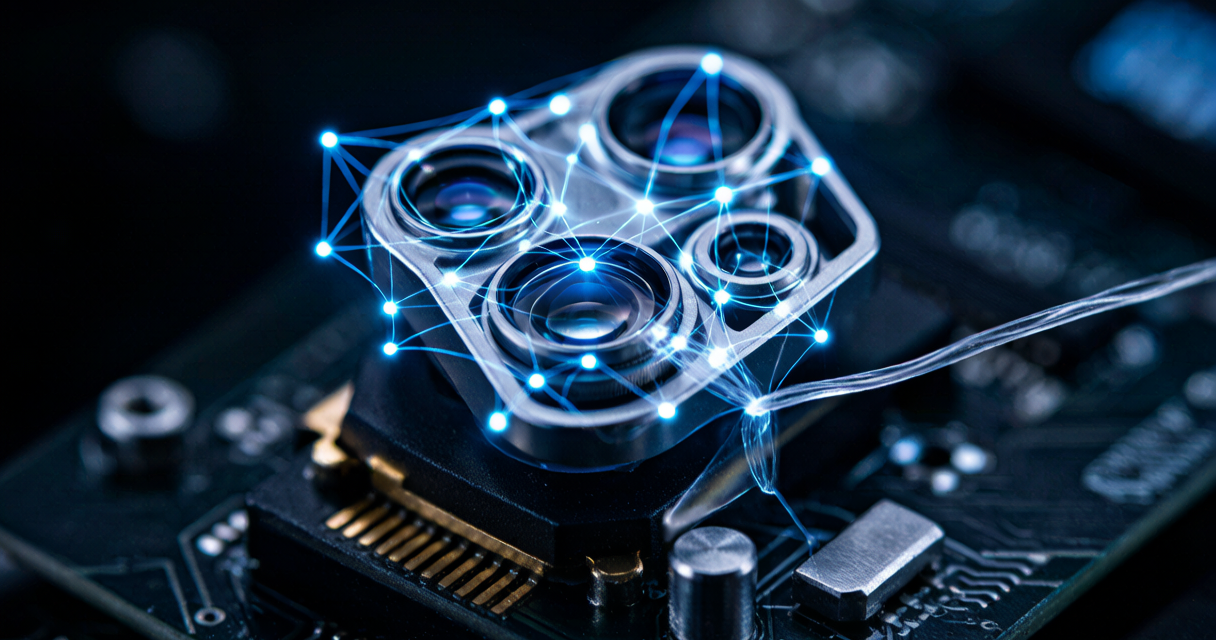
KYOTO, December 3, 2025 — Kyocera Corporation has developed a triple lens AI-based high-resolution depth sensor that can recognize semi-transparent, thin, and fine line-shaped objects previously undetectable by traditional stereo cameras. The new sensor triples measurement precision for tiny objects — from 1mm down to 0.3mm — and will be showcased at CES 2026 in Las Vegas.
Why Three Lenses?
Conventional dual-lens stereo cameras acquire a single set of parallax information between left and right lenses. This approach struggles with objects that have limited surface features, repetitive patterns, or partial occlusion. Kyocera’s triple lens configuration acquires three sets of parallax data — “left-centre,” “centre-right,” and “left-right” — from a close distance of 10cm.
By combining multiple parallax datasets with proprietary AI, the system virtually eliminates mismatches and reduces blind spots, significantly improving measurement reliability. The AI processes all three parallax combinations simultaneously, cross-validating results to achieve unprecedented accuracy for challenging materials.
Detecting the Previously Undetectable
The triple lens AI depth sensor can accurately measure distance to:
- Ultra-fine wires with diameters as small as 0.3mm — including wire harnesses and cables
- Reflective metal objects that confuse traditional stereo cameras with specular reflections
- Translucent plastics that allow light to pass through, creating phantom depth readings
- Thin, irregularly shaped linear objects positioned parallel to the lens direction
The sensor measures just 28mm × 30mm × 40mm (W × D × H), making it compact enough for integration into robotic end-effectors and close-range inspection systems.
Three Industries Transformed
1. Manufacturing Inspection
In inspection processes involving objects with highly repetitive patterns — such as electronic circuit boards or textiles — dual-lens stereo cameras are prone to mismatching. The triple lens configuration significantly increases measurement accuracy by utilizing multiple parallax combinations, enabling precise analysis of depth and surface shape while minimizing false readings.
2. Surgical Robotics
Thin, highly reflective surgical tools such as needles and sutures are often hard to distinguish against tissue backgrounds and can be partially hidden from view. The triple lens camera’s three viewpoints enable precise position recognition by combining information from multiple angles, increasing accuracy and reliability in identifying surgical instruments during minimally invasive procedures.
3. Agricultural Robotics
In crop harvesting and complex environments where fruits and leaves occlude each other, the triple lens camera enables more accurate recognition and precise position measurement with minimal blind spots — a critical capability for autonomous harvesting robots operating in unstructured agricultural settings.
Evolution from Dual to Triple Lens
In 2024, Kyocera developed a dual-lens AI depth sensor capable of 100μm resolution at a 10cm range, allowing distance measurement of objects around 1mm in size — even reflective or semi-transparent ones. However, dual-lens systems still struggled with objects lacking distinct features or partially obscured from view. The triple lens design was created specifically to solve these remaining challenges.
The improvement is dramatic: where the dual-lens system could measure objects down to 1mm, the triple lens system achieves 0.3mm precision — a 3x improvement that brings machine vision into realms previously reserved for specialized laser measurement systems.
At CES 2026
The triple lens AI depth sensor will be exhibited at Kyocera’s booth #6501 in the Vehicle Tech & Advanced Mobility Zone, West Hall, at CES 2026 (January 6–9, 2026, Las Vegas Convention Center). Visitors will be able to compare its recognition accuracy with conventional products in real-time demonstrations.
As labor shortages drive demand for automation across manufacturing, healthcare, and agriculture, Kyocera’s triple lens technology represents a meaningful step toward robots that can perceive and manipulate the full range of objects in human environments — including those that have long eluded machine vision systems.