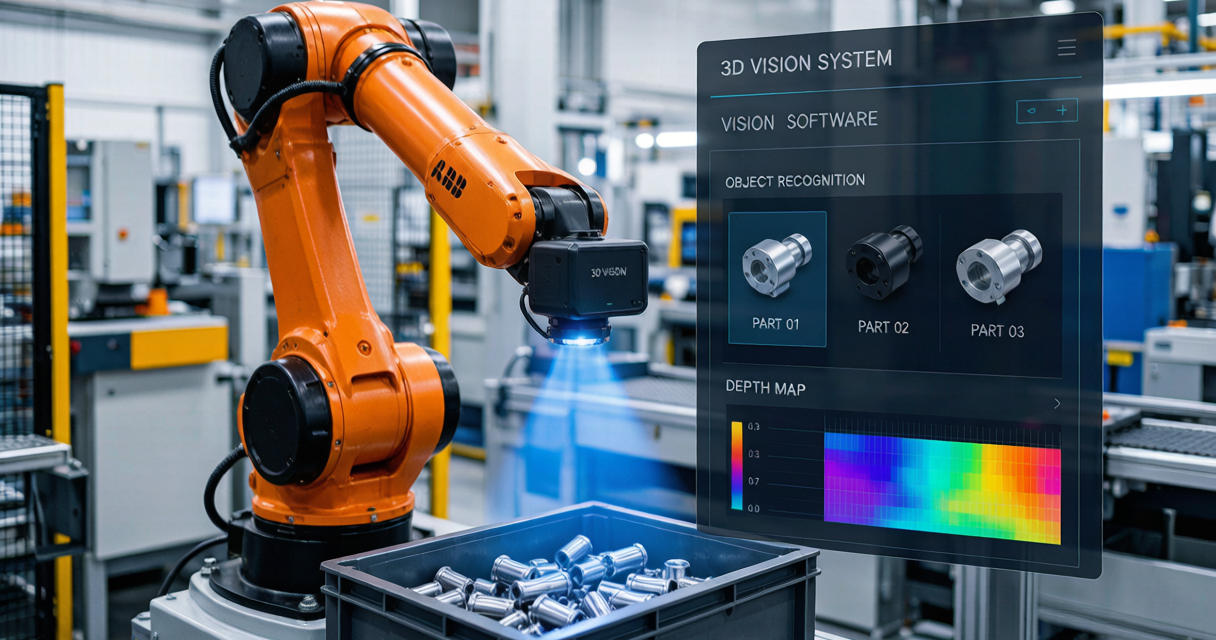
In September 2025, Photoneo—now part of Zebra Technologies—joined the ABB Robotics ecosystem, embedding its Locator Studio and Bin Picking Studio software directly into ABB One and OmniCore robot controllers. This integration represents a significant shift in how 3D vision technology reaches end users: rather than selling standalone sensors that require custom integration, vision providers are embedding their capabilities inside the robot controller itself.
What Was Integrated
Photoneo’s integration with ABB brings two key software products into the robot control layer:
Locator Studio
Locator Studio enables robots to locate and identify parts in unstructured environments. Using Photoneo’s high-resolution PhoXi 3D scanners, the software generates detailed point clouds of workspaces, then applies model-based matching algorithms to determine the position and orientation of target objects. By running inside the ABB controller, Locator Studio eliminates the latency and complexity of communicating with an external vision server.
Bin Picking Studio
Bin Picking Studio handles the complete pick-and-place workflow: scene acquisition, object recognition, grasp planning, collision-free path generation, and execution. The software supports arbitrary part geometries and can handle tangled, stacked, or randomly oriented parts in bins and totes. Integration with ABB’s OmniCore controller means that grasp plans are executed directly through ABB’s motion control pipeline, without middleware translation layers.
Why Controller-Level Integration Matters
Historically, adding 3D vision to a robot cell required stitching together multiple components: a 3D camera, a vision processing PC, software for object recognition and grasp planning, a communication layer to the robot controller, and safety logic. Each interface added potential failure points, calibration requirements, and integration effort.
When vision software runs inside the robot controller, several things change:
- Reduced integration time: No need to set up and configure a separate vision server; the software is part of the controller’s firmware
- Lower latency: Vision commands execute within the controller’s real-time loop, eliminating network communication delays
- Simplified support: One vendor (ABB) handles the entire stack, reducing finger-pointing between camera, software, and robot suppliers
- Easier procurement: Customers buy a robot with vision built in, rather than sourcing and validating separate components
The Broader Industry Pattern
Photoneo’s integration with ABB is not an isolated event. Throughout 2024–2026, the 3D vision industry has been moving toward tighter coupling between perception and control. Several parallel developments illustrate this trend:
Mech-Mind: Eye-Brain-Hand at AW2026
At AW2026, Beijing-based Mech-Mind Robotics demonstrated its “Eye-Brain-Hand” embodied intelligence solution, presenting perception (Mech-Eye 3D cameras), decisioning (Mech-Vision and Mech-Viz software), and execution (robot arm) as a unified system. The approach reinforces the idea that advanced robotic tasks require perception, planning, and motion to work as one integrated pipeline—not as separately purchased components.
Photoneo Under Zebra Technologies
Photoneo’s acquisition by Zebra Technologies, completed in 2024, itself reflects the integration trend. Zebra, known for barcode scanning, RFID, and enterprise asset visibility, added 3D machine vision to its portfolio to offer end-to-end solutions spanning identification, perception, and automation. The ABB ecosystem integration is a natural extension of this strategy.
Orbbec and Teradyne Robotics
At Automate 2026, Orbbec announced that Teradyne Robotics integrated its Gemini 305g cameras into the UR AI Trainer for physical AI data collection. While this is a hardware-level integration rather than controller-level, it represents the same pattern: vision companies partnering with robot manufacturers to deliver pre-integrated solutions.
Market Impact and Competitive Dynamics
The 3D vision for robotics market was valued at $3.25 billion in 2025 and is projected to reach $9.47 billion by 2032, growing at a CAGR of 16.5%. As the market grows, the competitive landscape is shifting:
- Camera specialists (Orbbec, Zivid, Basler) are forming partnerships with robot OEMs to ensure their sensors are “design-recommended” for specific platforms
- Vision software companies (Photoneo, Mech-Mind, Cognex) are embedding their algorithms inside robot controllers to lock in platform relationships
- Robot manufacturers (ABB, FANUC, KUKA) are building ecosystems of certified vision partners, making it easier for end users to deploy vision-guided robotics without custom integration
For end users, this consolidation is largely positive. Pre-integrated vision systems reduce deployment time, simplify support, and lower total cost of ownership. The trade-off is reduced flexibility—customers who want to mix and match best-of-breed components from different vendors may find it harder to do so as ecosystem partnerships create de facto preferred supplier relationships.
What’s Next: Vision as a Controller Feature
The trajectory is clear: 3D vision is becoming a standard feature of robot controllers, not an add-on. Just as modern robot controllers include built-in motion planning, safety monitoring, and fieldbus communication, they will increasingly ship with integrated 3D perception capabilities. The Photoneo-ABB integration is an early step in this direction.
For integrators and end users, the practical implication is to evaluate robot platforms not just on payload, reach, and repeatability, but on the breadth and maturity of their vision ecosystem. A robot with a well-integrated 3D vision stack may deliver faster time-to-production than a higher-spec robot that requires custom vision integration.
As the industry continues to consolidate, expect more vision providers to join robot manufacturer ecosystems—and expect the line between “vision system” and “robot controller” to continue blurring.