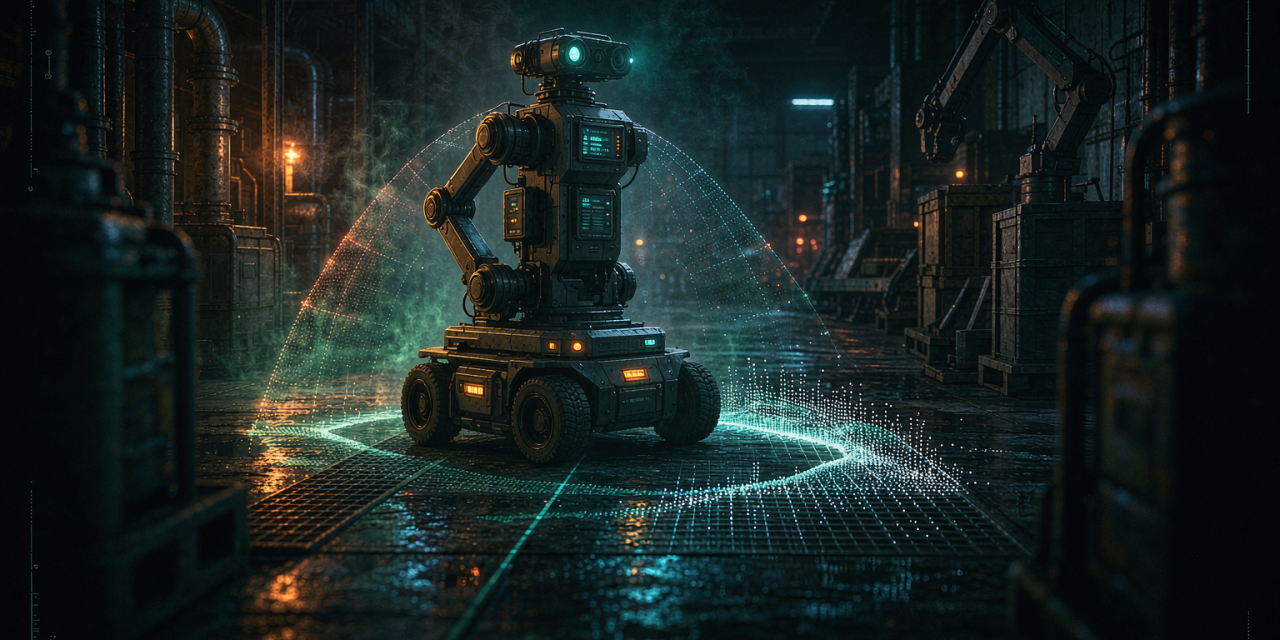
RGB cameras have carried robot vision for decades, but they share a stubborn weakness: they depend on visible light. In pitch-dark warehouses, sun-glare loading docks, smoky sites, or driving rain, a color image collapses and the perception stack goes blind. The 2026 research frontier is pushing robotic perception past the RGB assumption – fusing depth, thermal, and event data so robots can keep operating when ordinary cameras cannot.
## Thermal-to-Depth: Seeing Heat Instead of Color
A standout result this year is Thermal-to-Depth Gaussian Splatting (TDg) from the Technical University of Munich. It reconstructs a 3D radiance field using only thermal infrared images plus a depth estimate, challenging the long-held assumption that RGB data is essential for 3D scene understanding. By training on RGBT-Scenes and ThermalMix datasets and folding in the Marigold depth estimator, TDg produces robust 3D reconstruction in lighting- and weather-agnostic scenarios where a color camera would fail outright. For inspection, search-and-rescue, and night logistics, a heat signature is often more informative than a texture anyway.
## Low-Light 3D Without the Two-Step Tax
Low-light has its own fix. DelowlightSplat, from Hangzhou Dianzi University, tackles feed-forward 3D Gaussian reconstruction in dark conditions by integrating low-light adaptation directly into the pipeline. Older approaches restored the image first, then reconstructed – a two-stage path that loses detail at each hop. DelowlightSplat beats those restore-then-reconstruct methods by adapting within the reconstruction itself, keeping geometry sharp where traditional pipelines smear.
## Unifying Manipulation, Navigation, and Trajectory
On the model side, Qwen-VLA from Qwen AI unifies robot manipulation, navigation, and trajectory prediction into a single vision-language-action foundation model, built on a DiT-based flow-matching action decoder. The key insight: manipulation, navigation, and trajectory-centric tasks are all manifestations of one shared action-and-trajectory prediction problem, solvable by one model with embodiment-aware prompting. FineVLA refines control further, showing that mixing fine-grained and goal-level language instructions in a 1:1 to 1:2 ratio yields the most steerable policies – useful for pose- and approach-sensitive tasks. For the edge, ESAM++ delivers efficient online 3D perception through a lightweight 3D Sparse Feature Pyramid Network, evaluated on ScanNet and SceneNN.
## What It Means for Robot Cameras
The throughline is clear: future perception stacks will not rely on a single RGB sensor. The winning design fuses RGB for semantics, depth for geometry, thermal for lighting independence, and event streams for high-speed motion – each modality covering the others’ blind spots. Camera makers are already responding with multimodal modules that output aligned RGB, depth, and infrared simultaneously. For robot builders, the takeaway is practical: specify sensors for the worst lighting and weather your robot will actually meet, not the best. Robust autonomy in the real world is a fusion problem, and 2026’s research shows the fusion getting lighter, cheaper, and far more dependable.