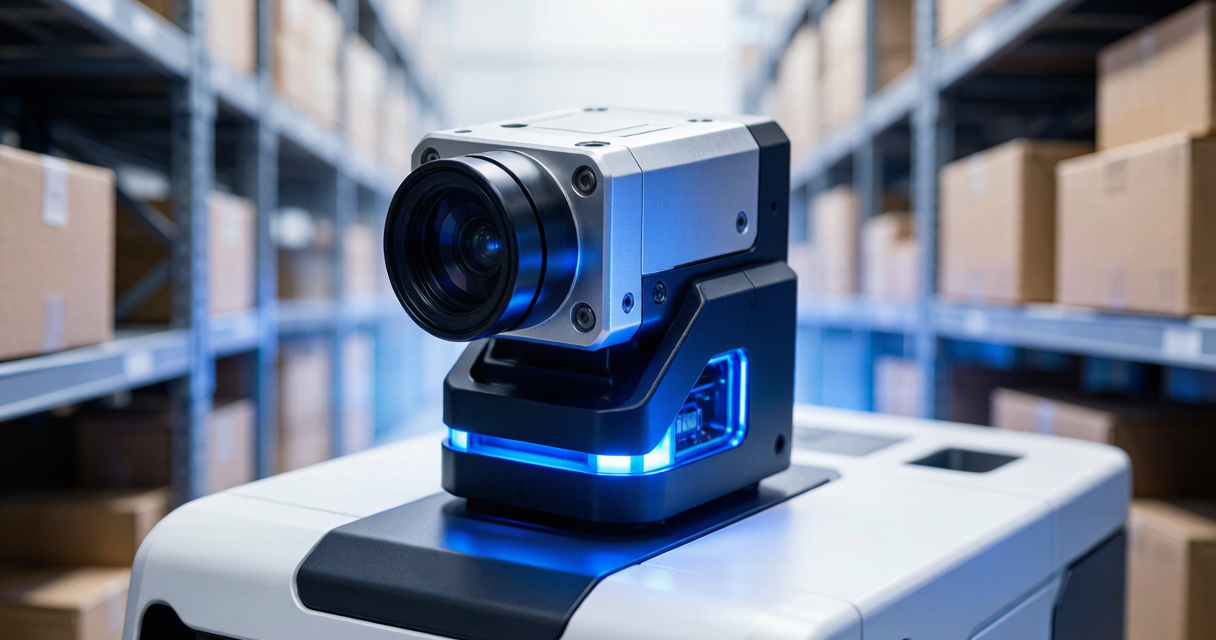
At LogiMAT 2026, the international trade fair for intralogistics, Basler AG and Orbbec announced a technology partnership and jointly launched the Basler Stereo mini 3D camera, a compact depth sensor purpose-built for autonomous mobile robots (AMRs) and logistics applications. The partnership reflects a broader industry trend: camera manufacturers are moving beyond standalone sensors toward tightly packaged perception stacks that integrate directly with robot platforms.
The Basler-Orbbec Partnership
Basler AG, headquartered in Ahrensburg, Germany, brings decades of expertise in industrial machine vision cameras. Orbbec, based in Shenzhen with a U.S. office in Troy, Michigan, is one of the world’s largest manufacturers of 3D depth cameras, with particular strength in stereo, structured light, and ToF technologies. The collaboration combines Basler’s industrial-grade manufacturing and quality standards with Orbbec’s depth-sensing R&D capabilities.
The Basler Stereo mini represents the first joint product of this partnership. Designed for AMRs operating in warehouses and distribution centers, the camera addresses the specific perception needs of logistics robots: obstacle detection in narrow aisles, pallet recognition, and safe navigation in dynamic environments where humans and forklifts share the floor.
Why AMRs Need Purpose-Built 3D Cameras
Autonomous mobile robots in logistics face perception challenges that differ significantly from those in factory automation. Warehouse environments feature:
- Repetitive structures: Rows of identical shelving units that confuse visual SLAM systems
- Dynamic obstacles: Workers, forklifts, and other AMRs appearing and disappearing unpredictably
- Mixed lighting: Dark storage zones transitioning to bright loading dock areas
- Reflective surfaces: Shrink wrap, metal shelving, and polished floors that scatter structured light patterns
- Space constraints: Narrow aisles requiring compact sensors that don’t protrude from the robot body
A general-purpose 3D camera struggles with these conditions. The Basler Stereo mini is optimized for the AMR form factor, with mounting options and environmental ratings suited to the warehouse floor.
The Broader Trend: Ecosystem Partnerships in 3D Vision
The Basler-Orbbec partnership is part of a larger pattern reshaping the 3D vision industry. Throughout 2025 and 2026, camera manufacturers have been forming strategic alliances rather than competing purely on hardware specs. Several notable developments:
Zivid 3: Simultaneous 2D and 3D Capture
At AW2026, Norwegian company Zivid showcased the Zivid 3 camera, optimized for depalletizing and large bin picking. The camera’s distinguishing feature is its ability to capture 2D and 3D data simultaneously, supporting physical AI workflows that require both color and depth information in a single frame. This dual-capture capability eliminates the need for separate 2D and 3D cameras on bin-picking stations, reducing system complexity and calibration overhead.
Voyis Discovery Stereo: Subsea 3D Perception
Voyis launched its Discovery Stereo Perception Series (P300/P3000) for subsea autonomy and real-time 3D perception in underwater robotics. This signals growing demand for stereo depth sensing in challenging environments beyond the factory floor, where extreme pressure and unusual lighting conditions require specialized optical design.
Leopard Imaging Eagle: Day/Night Robotic Vision
Leopard Imaging announced its Eagle series RGB-IR active stereo cameras for day/night robotic vision, anchored on NVIDIA Holoscan and Jetson Thor platforms. The RGB-IR approach enables depth sensing in both daylight and complete darkness, expanding the operational envelope for outdoor robots and security applications.
AMR Market Dynamics Drive Demand
The 3D cameras for AMRs market reached an estimated $1.09 billion in 2025, with Asia Pacific accounting for approximately 40% of global demand. Time-of-Flight (ToF) technology led the market with 47.8% share, followed by stereo vision. The market is projected to grow at a CAGR of 16.5% through 2032, driven by warehouse automation, e-commerce fulfillment, and manufacturing logistics.
As AMR deployments scale from dozens to hundreds of units per facility, the total cost of ownership for 3D vision systems becomes a critical factor. Purpose-built cameras like the Basler Stereo mini—designed specifically for the AMR form factor and operating environment—can reduce integration time, lower maintenance costs, and improve reliability compared to repurposed general-purpose sensors.
The Integration Imperative
What sets the current wave of 3D camera partnerships apart from earlier iterations is the focus on integration readiness. Camera manufacturers understand that AMR developers want sensors that plug into existing robot platforms with minimal engineering effort. This means:
- Standardized mechanical interfaces compatible with common AMR chassis designs
- Software drivers for popular robot operating systems (ROS 2, Isaac SDK)
- Environmental ratings (IP65/IP67) that match warehouse durability requirements
- Power consumption profiles suited to battery-powered mobile platforms
The Basler-Orbbec partnership, along with similar alliances across the industry, signals that the 3D vision market is maturing. The winners will be those who can deliver not just the best sensor specs, but the easiest path from unboxing to deployed perception.