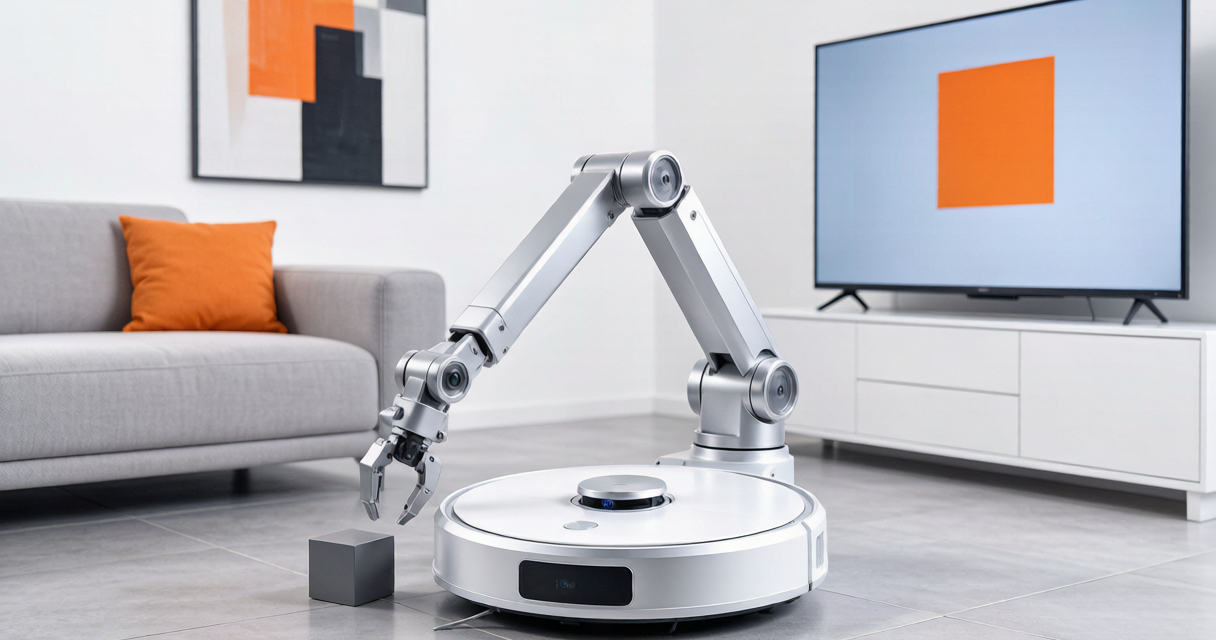
The Roborock Saros Z70, unveiled at CES 2025 in Las Vegas and launched in Germany in early 2025, represents a genuine breakthrough in consumer robotics: the industry’s first 5-axis robot arm integrated into a robotic vacuum cleaner. This arm can physically move obstacles out of the robot’s path and clean areas that were previously inaccessible. The enabling technology? Infineon’s REAL3 Time-of-Flight (ToF) sensors, jointly developed with pmdtechnologies.
The ToF Miniaturization Breakthrough
The key to fitting a functional 5-axis arm into a consumer-sized robot vacuum was sensor miniaturization. Infineon’s REAL3 ToF technology is 100 times smaller than conventional laser distance scanners. This dramatic size reduction freed up the internal space needed to integrate a retractable robot arm while maintaining the sleek, slim design consumers expect.
Without this miniaturization, the Saros Z70 would have required a significantly larger chassis—making it too bulky for typical home environments. The ToF sensor’s compact form factor is what made the entire product concept viable.
Dual ToF Cameras for Navigation and Manipulation
The Saros Z70 uses Infineon ToF technology in two distinct roles:
- Primary navigation ToF: Replaces conventional laser distance scanners for room mapping, obstacle detection, and path planning. Delivers best-in-class performance and space efficiency for autonomous navigation.
- Arm operation ToF camera: An additional ToF camera dedicated to guiding the 5-axis robot arm. This camera ensures precise, smooth arm movements when the robot reaches for obstacles to move them aside.
This dual-sensor architecture separates navigation perception from manipulation perception, allowing each system to be optimized independently without competing for computational resources.
What the 5-Axis Arm Actually Does
The Saros Z70’s arm isn’t a gimmick. In real-world cleaning scenarios, it addresses a long-standing frustration with robot vacuums: objects left on the floor that block cleaning paths. The arm can:
- Pick up and relocate lightweight obstacles like socks, toys, and cables
- Move items away from walls and corners where the vacuum head cannot reach
- Clean previously blocked areas after clearing the obstruction
- Retract fully into the chassis when not in use, maintaining the robot’s low profile
Infineon’s Strategic Bet on Sensor-Driven Robotics
For Infineon, the Roborock partnership validates a broader strategy. Andreas Kopetz, Vice President of Ambient Sensing at Infineon, called it “a major breakthrough that Roborock has recognized the full potential of Infineon’s sensor technology and transformed it into an innovative product that consumers have never seen before.”
Infineon has consolidated its sensor and RF expertise into a new business unit called SURF (Sensor Unit and Radio Frequency), aiming to capitalize on a sensor and RF market projected to exceed $20 billion by 2027. The company is positioning itself as a leading supplier of perception components for the robotics industry, from consumer vacuums to industrial AMRs.
pmdtechnologies: The ToF Pioneer Behind the Sensor
The REAL3 ToF imager was jointly developed with pmdtechnologies ag, a fabless IC company headquartered in Siegen, Germany. Founded in 2002, pmd holds over 450 worldwide patents related to 3D Time-of-Flight CMOS imaging technology. The company serves industrial automation, automotive, and consumer applications.
pmd’s core innovation is the pmd measurement principle—a proprietary approach to indirect Time-of-Flight sensing that achieves high accuracy and robustness in a CMOS-compatible process. This makes it possible to manufacture ToF sensors at scale using standard semiconductor foundries, driving down costs for high-volume consumer applications.
Implications for the Robotics Industry
The Saros Z70 demonstrates that ToF sensor miniaturization has reached a tipping point. When a sensor becomes 100x smaller without sacrificing performance, entirely new product categories become possible. The 5-axis arm in a consumer vacuum is just the beginning.
For the broader robotics industry, this trend has several implications:
- Consumer robotics will become more manipulative: Arms and grippers will appear in products beyond vacuums—potentially in home assistance robots and educational platforms
- ToF will displace laser scanners in cost-sensitive applications: The size and cost advantages of ToF make it increasingly attractive over traditional LiDAR for short-range perception
- Sensor-to-product integration will accelerate: As semiconductor companies like Infineon build dedicated sensor business units, the path from sensor innovation to consumer product will shorten
The Hybrid ToF Future
Infineon has published a whitepaper titled “Enabling the next generation of smarter self-navigating robots using Hybrid ToF,” suggesting that future sensor architectures will combine ToF with other sensing modalities. Hybrid approaches—pairing ToF with stereo vision, structured light, or radar—could deliver the best of each technology while compensating for individual weaknesses.
As consumer robots evolve from passive cleaners to active manipulators, the demand for compact, power-efficient, and high-performance depth sensors will only grow. The Roborock Saros Z70 is an early indicator of where the market is heading.