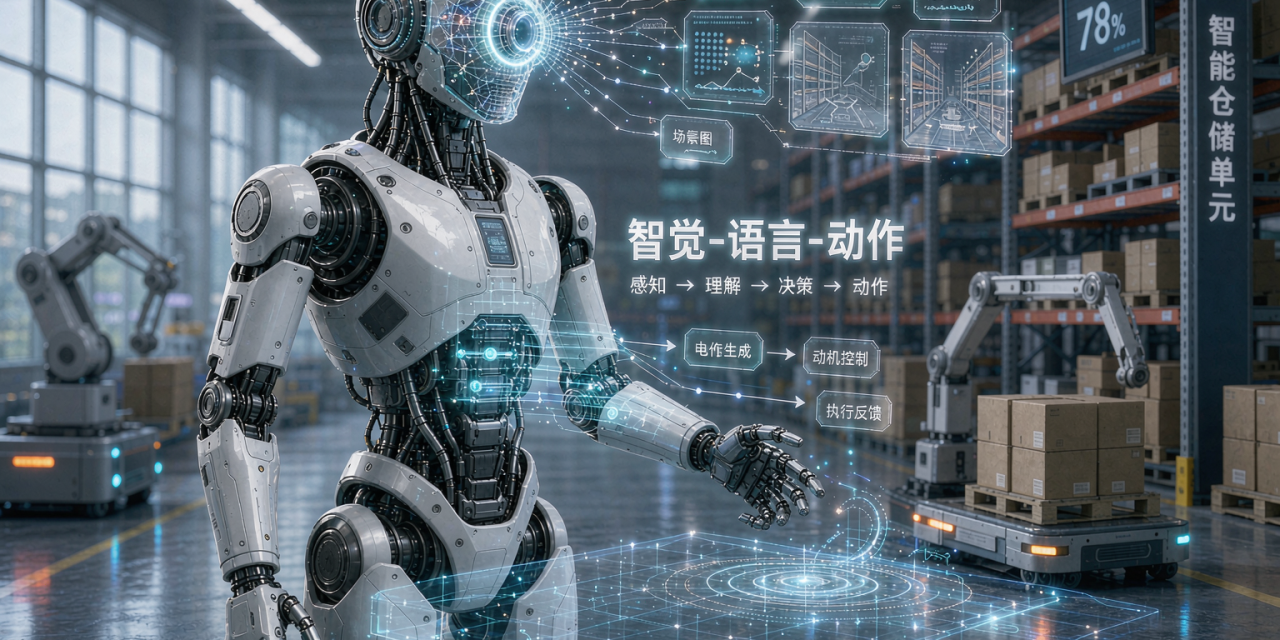
Physical AI – artificial intelligence embodied in robots that perceive, reason about, and act in the physical world – crossed a decisive threshold in 2026. Foundation models trained on massive cross-embodiment datasets now let robots generalize across tasks and environments that were research fantasies three years ago, and the dominant architecture carrying that progress is the Vision-Language-Action (VLA) model.
## From Pixels and Words to Motor Commands
A VLA model collapses perception, reasoning, and action into a single end-to-end neural network that maps directly from camera pixels and a language instruction to motor commands. Rather than hand-engineering interfaces between a vision module, a planner, and a controller, a VLA learns the whole loop at once – which costs more data and compute but generalizes far better than modular pipelines. The vision backbone is typically a Vision Transformer such as ViT or SigLIP; the language backbone is an LLM such as LLaMA or Gemma; and the action head is a flow-matching or diffusion model that outputs smooth trajectories or joint torques.
Several models now define the state of the field. Pi0 from Physical Intelligence (over $400M raised) uses a vision-language backbone with a flow-matching action head and demonstrates cross-task generalization – one checkpoint can fold laundry, clear tables, and pack boxes across multiple embodiments. NVIDIA’s GR00T N1 runs a dual-system design: a “slow” VLA backbone at 2-5 Hz for task reasoning and a “fast” policy at 200+ Hz for reactive motor control. Google DeepMind’s Gemini Robotics ER 2, released in July 2026, adds continuous video understanding and multi-robot coordination. NVIDIA’s Alpamayo 2 Super, opened for commercial use in August 2026, processes full-surround camera input for robotaxi and Level 4 driving. OpenVLA (7B) and Octo (93M) give the community open, fine-tunable baselines.
## Capital and Deployments at Scale
Investment has followed. Robotics and Physical AI startups raised roughly $15 billion globally in 2025 and had already attracted about $18.8 billion by late June 2026; PitchBook estimates $16.3 billion across 492 deals in the first quarter of 2026 alone – its strongest quarter on record. Deployments are proving the thesis: Figure AI’s humanoids completed an 11-month run at BMW’s Spartanburg plant, logging more than 1,250 operating hours and moving over 90,000 components, while Waymo removed its Dallas waitlist in August 2026 after serving nearly 150,000 riders.
## Why Cameras Sit at the Center
None of this works without eyes. The perception layer of every VLA runs on two to four camera views, typically at 224×224 or 336×336 resolution, feeding a ViT backbone at 10-50 Hz. The quality, latency, and synchronization of those cameras – RGB, depth, and event – directly bound what the foundation model can see and therefore what the robot can do. As Physical AI scales from warehouse to street, robotic vision hardware is no longer a peripheral; it is the front end of the model itself.