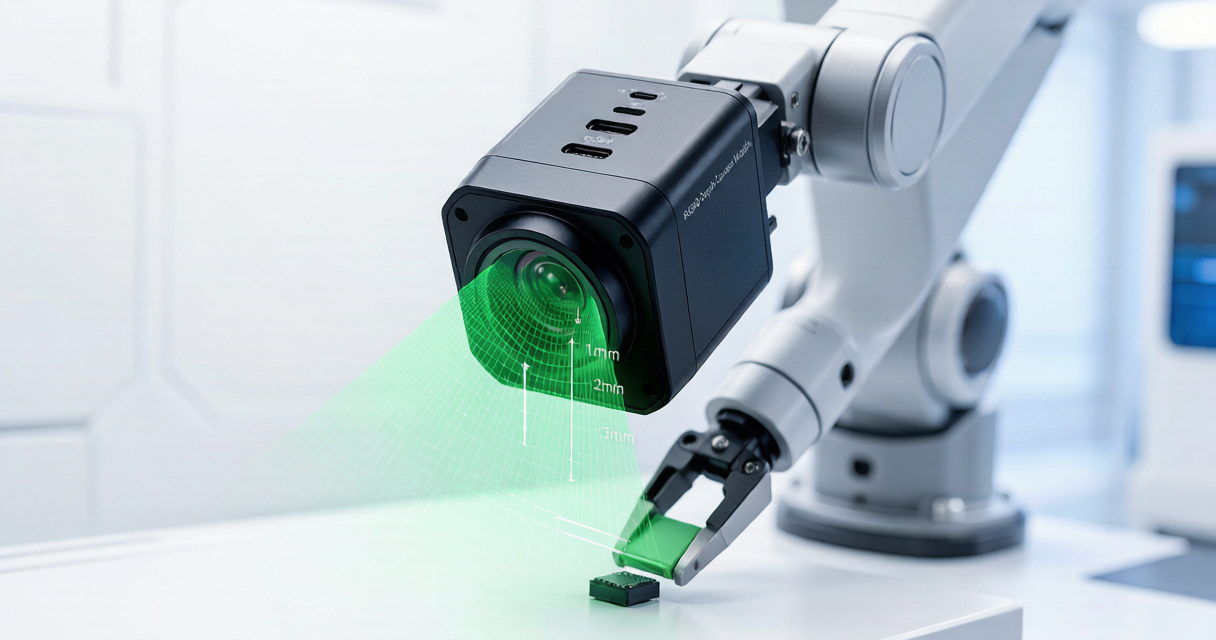
Shenzhen, June 8, 2026 — O-Film, formerly one of the world’s largest smartphone camera module manufacturers, has officially entered the robotics vision market with the launch of the Dex400R RGBD depth camera. As the first product in O-Film’s RoboVision series, the Dex400R is purpose-built for robot arm grasping, data collection, and obstacle avoidance across general-purpose robotics scenarios.
## Compact Form Factor for Wrist Mounting
The Dex400R is designed to mount directly on the wrist of a robotic arm, giving the robot what amounts to a pair of eyes that move with the end-effector. The camera measures just 45 mm x 28 mm x 28 mm and weighs approximately 170 grams, making it one of the most compact RGBD cameras in its class.
By placing the camera on the wrist rather than on a fixed external bracket, the Dex400R enables the robot to observe workpieces from any angle as the arm moves, overcoming the limited field of view and occlusion problems that plague traditional fixed-mount vision systems. This is particularly valuable for bin picking, precision assembly, and screw fastening applications.
## Precision Specifications
The camera’s specifications are tightly aligned with the needs of robotic grasping. At close range (10-20 cm), the Dex400R achieves identification precision of less than 1.5 mm, providing millimeter-level perception for delicate manipulation tasks. At longer distances, the error remains below 1%. The minimum sensing distance is just 5 cm, eliminating the blind zone that typically plagues depth cameras at close range.
The camera outputs RGB, depth, and infrared data simultaneously via its RGBD four-channel system, with depth resolution up to 640 x 480 at 30 fps. An integrated global shutter eliminates motion blur during high-speed arm movement, while a built-in IMU provides motion compensation and enables visual-inertial data fusion for improved mapping accuracy in open environments.
## Industry-First Dual Interface
A standout feature of the Dex400R is its USB + GMSL dual interface design, which O-Film claims is the only such configuration in its product category. The USB 3.0 Type-C interface supports local direct connection for development and testing, while the GMSL interface enables long-distance, EMI-resistant transmission up to 15 meters for industrial deployment scenarios. This dual-interface approach allows the same camera to serve both lab development and factory floor deployment without hardware changes.
The camera also supports D2C (Depth-to-Color) alignment, IMU synchronization, data collection, and external trigger modes, reducing integration complexity and shortening project deployment cycles.
## Application Scenarios
O-Film has identified three primary application scenarios for the Dex400R:
**Bin Picking (Disordered Grasping):** Automotive parts, 3C electronics components, and castings scattered in material bins can be individually identified and grasped. The camera’s optimized anti-reflection and anti-structured-light-interference algorithms provide stable recognition of metallic and black plastic parts.
**Precision Assembly:** For tasks such as connector insertion, alignment, and clip pressing where part gaps are only a few millimeters, the camera’s close-range high-precision depth information enables fine manipulation.
**Welding and Dispensing Guidance:** The camera pre-scans weld seams or adhesive paths, allowing the robot arm to automatically follow the trajectory, suitable for multi-variety small-batch production.
## O-Film’s Strategic Pivot
The Dex400R represents O-Film’s strategic pivot from smartphone optics to robotics vision. Once the world’s largest mobile camera module supplier, O-Film has been actively expanding into smart automotive, VR/AR, and robotics markets. The RoboVision series and its Dex400R launch product signal the company’s ambition to become a major player in the 3D vision supply chain for embodied intelligence.
According to Morgan Stanley forecasts cited by O-Film, China’s robotics market will expand at an average annual growth rate of 23%, reaching an estimated $108 billion by 2028. The Dex400R is positioned to capture demand from this rapidly growing market, offering a compelling combination of compact size, dual-interface flexibility, and millimeter-level precision for general-purpose robot arm applications.
The camera supports ROS and provides SDK access in both C++ and Python, with an operating temperature range of 0-50 degrees Celsius suitable for most factory environments.